71 West Ferry Street and Stone Row
Beyond the Door
05 June 2026
71 West Ferry Street and Stone Row (aka Regent’s Row)
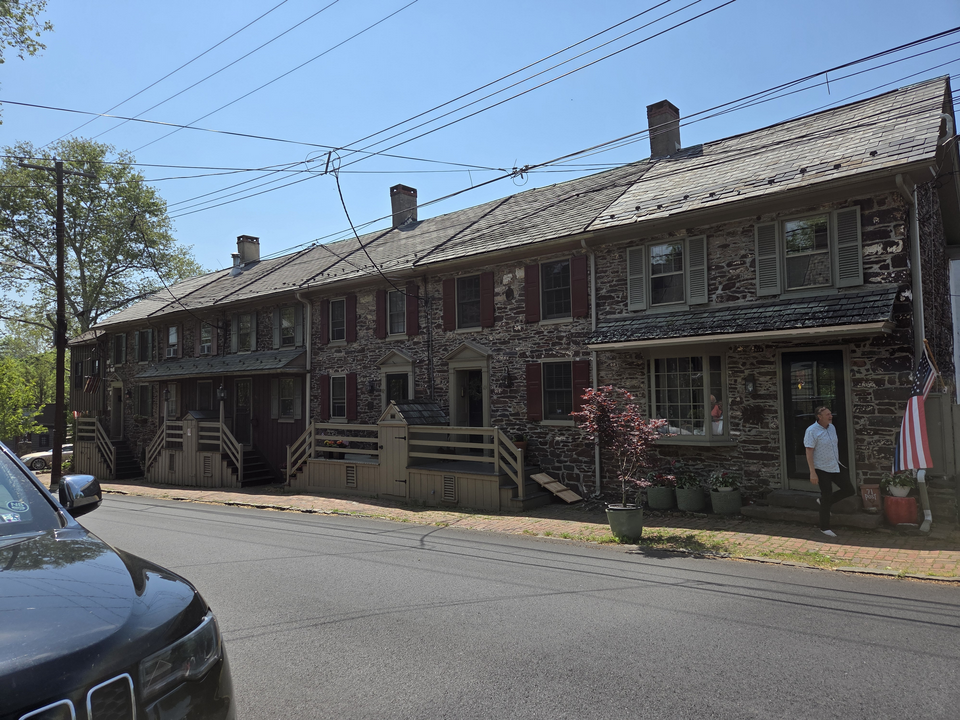
Stone Row, 71 West Ferry Street and owner Lou Bellafronte on the right
A row of homes on West Ferry Street is deeply connected to the history of New Hope. Recently volunteers from the New Hope Historical Society (NHHS) toured one of those homes with its owner, Lou Bellafronte. This article will explore his home’s history and changes made over the nearly 250 years since it was built, as well as the general history of the row of attached homes called Stone Row, formerly Regent’s Row. Another long-term Stone Row resident, Shane S. Blische, provided historical details about these homes, as did the NHHS archives and other sources specifically mentioned in this article.
Stone Row is situated between Ingham (Aquetong) Creek and Ferry Street, which once served as a major stage coach route between Manhattan and Philadelphia. Prior to the New Hope Lambertville bridge being built in 1814 the ferry landing was at the base of Ferry Street just a short distance to the east of Stone Row.
NHHS archival records state that the earliest deeds for the land where Stone Row now stands include names such as James Logan, William Penn’s agent, and Jonathan Ingham. The archives state “Davis’ history of Bucks County notes the sale from James Logan to Jonathan Ingham for 25 pounds sterling in 1747.” The deed transferring the land to Jonathan Ingham reserved any potential copper mine mineral rights profits to Logan until 1754.
As New Hope historian, Roy Ziegler, details in his book “New Hope, Pennsylvania River Town Passages” the row of six homes at 61-71 West Ferry Street was built in the late 1780’s by New Hope entrepreneur John Addison Beaumont (1757-1834) to provide “company housing” for mill workers. One NHHS archival document calls this “the colonial counter-part of the contemporary condominium.” Beaumont’s own similar era home, identified by a historic marker, is just downhill on Ferry Street from these houses, adjacent to the subsequently built Delaware Canal. Additional title records at NHHS list well known New Hope surnames as row owners following John Beaumont, including Coryell, Parry, Magill, Maris, and Ely.
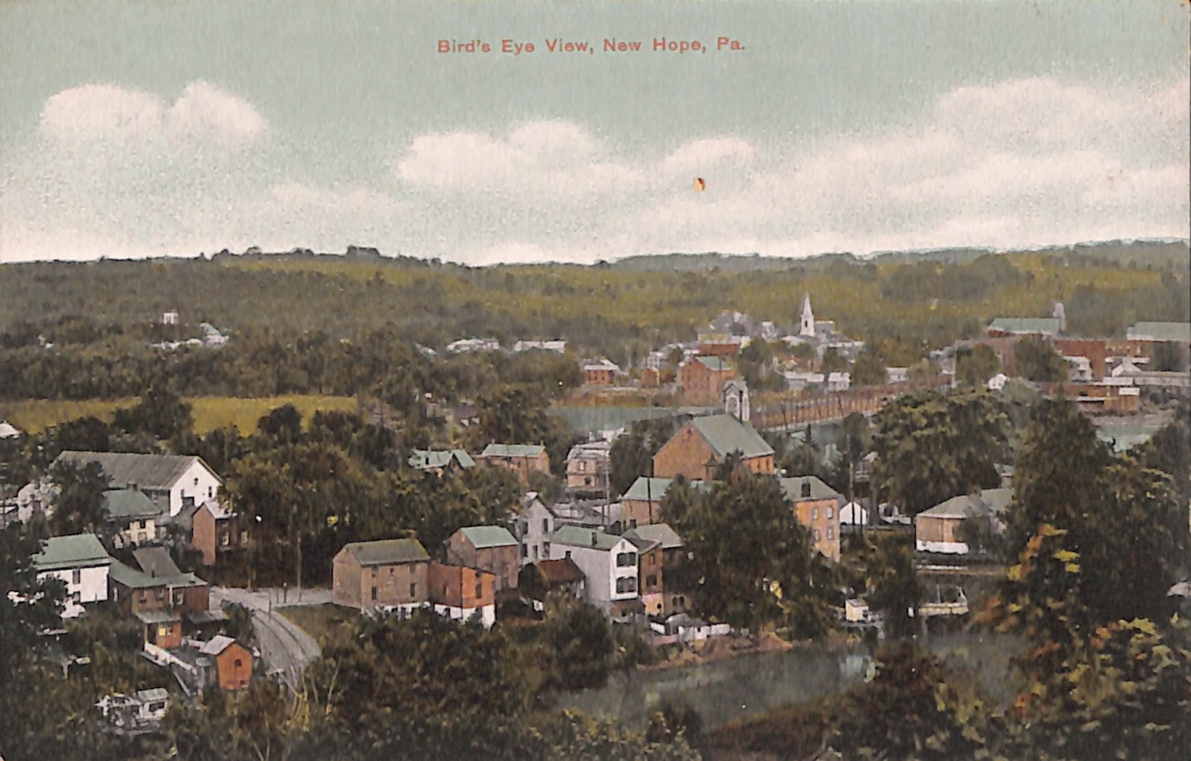
Undated postcard (perhaps pre-1910), with eastern end of Regent’s Row in the lower left-hand corner, from NHHS archives
As Ziegler further explains, over many years the row’s use as company housing abated, the housing fell into disrepair, and became known as New Hope’s “slums” by 1900. In about 1960 well known New Hope businessperson Pamela Minford purchased the row and began renovations. NHHS archival records show that in 1966 Charles and Nancy Eaton (once the NHHS Executive Director) purchased the row. Ziegler states they did additional extensive renovations. Outhouses were removed, indoor plumbing was added, and the Eaton’s home was added on the eastern end (57 and 59 West Ferry Street are now combined). Each original home was enlarged to the south providing space for dining rooms, dens, and modern baths, as noted below. Current Stone Row resident, Shane Blische, states in an email that for about 10 years the row was used like a motel (the newer, easternmost home was the office) including for touring famous actors from the Bucks County Playhouse and the Music Festival in Lambertville. Entangled deeds were finally separated in 1972 and the homes could then be sold as individual residences.
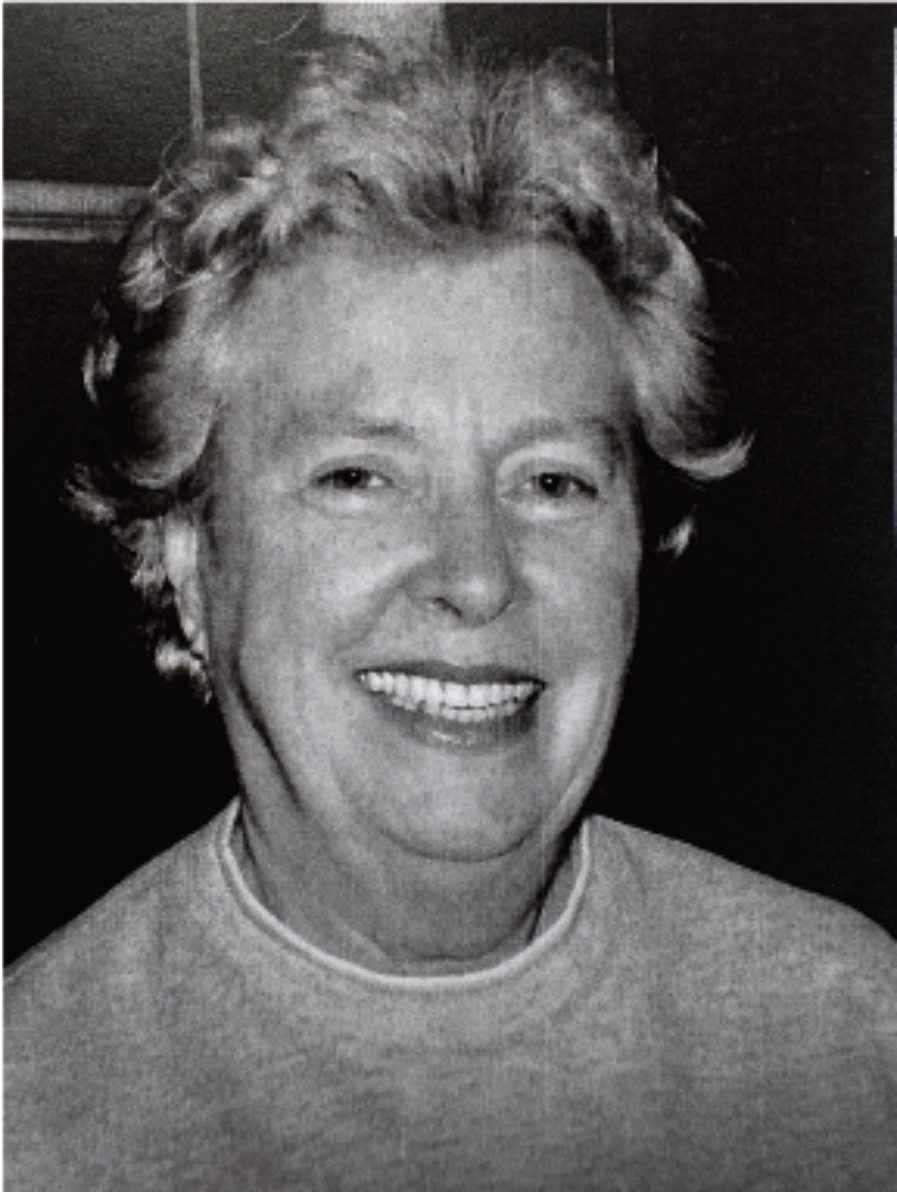
Pam Minford, photo from NHHS archives
Also found in the NHHS archives is a detailed 1978 architectural description of Stone Row by New Hope historian, Ann Niessen. She states “The 2 ½ story slate roofed fieldstone structure is in reality six separate single-family dwellings. Magnificently and faithfully restored both inside and out, all wood window sash and 6/6 glass panes are the original as are the door jambs…Each dwelling on the south (rear) elevation has been uniformly enlarged to accommodate a large dining room on the lowest level (which is above grade at this elevation), a den on the second level, a bath and open, uncovered wood porch on the third level. Three stucco-over-brick chimneys serve the six dwelling units...The Eaton family…removed the attic floor in five of the units to create an open loft effect. The sixth unit [71 West Ferry Street] on the west end of the structure retains its attic level. All original random width oak floors have been preserved as have all closed circular stairs and straight paneled wood doors. The stone of the interior walls has been exposed as have all original ceiling beams. The restoration was effected to provide exclusive resort accommodations for both tourists and professional New York theatre people, the latter performing at the famed Bucks County Playhouse.”
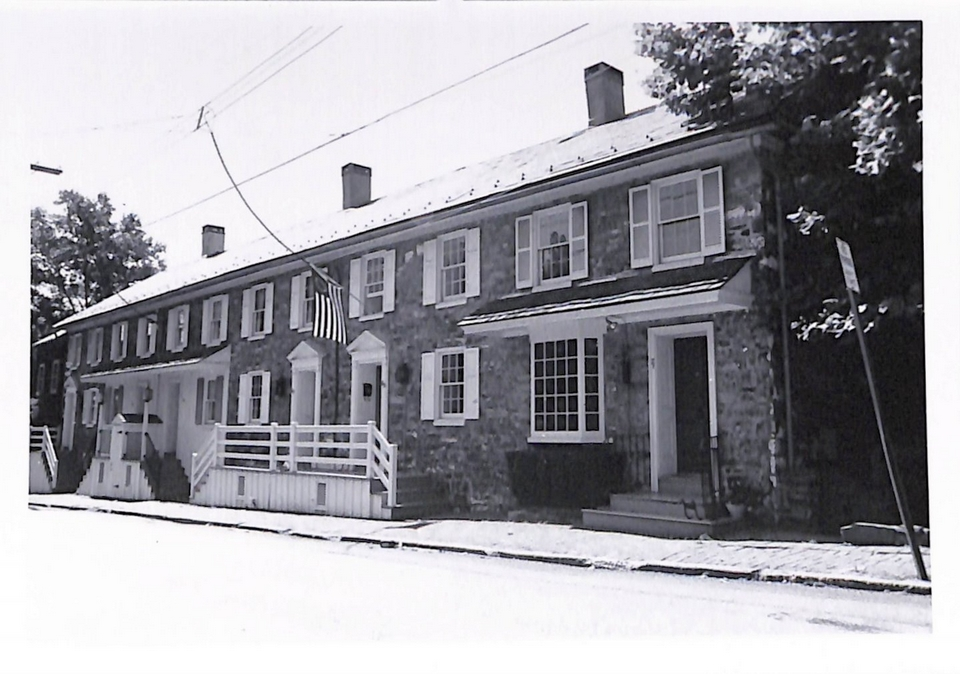
Stone Row, 1975, photo from NHHS archives
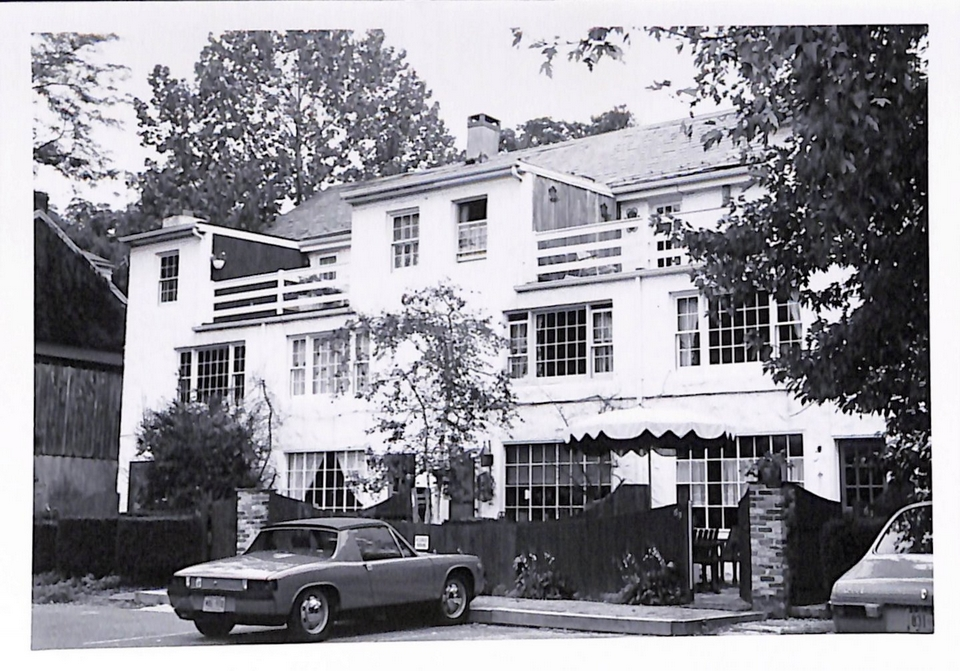
Stone Row from the rear (southern elevation), 1977, photo from NHHS archives
On a recent visit to 71 West Ferry Street (the westernmost end of Stone Row) owner Lou Bellafronte generously allowed us to see his nearly 250-year-old home. On the first floor there was evidence that until about 1800 the home was interconnected by an internal arch way to the home next door, which Lou states is a pattern through Stone Row. When this passageway was removed the space allowed stairs to be built to the 2nd floor, replacing the former ladder for that function. After purchasing the home about 6-7 years ago, Lou and his wife, Donna Morello, added a further southward addition with a 2-story window wall looking over a deck down to the Aquetong Creek and the railroad tracks above it. Original floor boards were maintained and additional boards from barns were added in the addition.
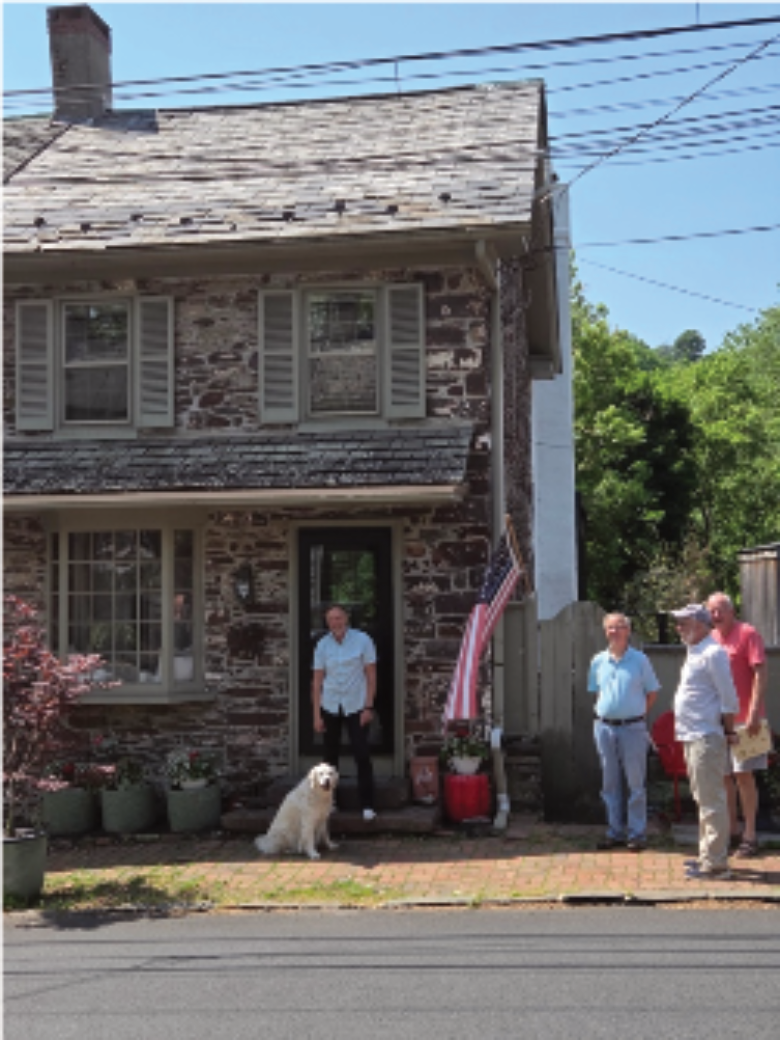
71 W Ferry St, owner Lou Bellafronte at door, and NHHS volunteers
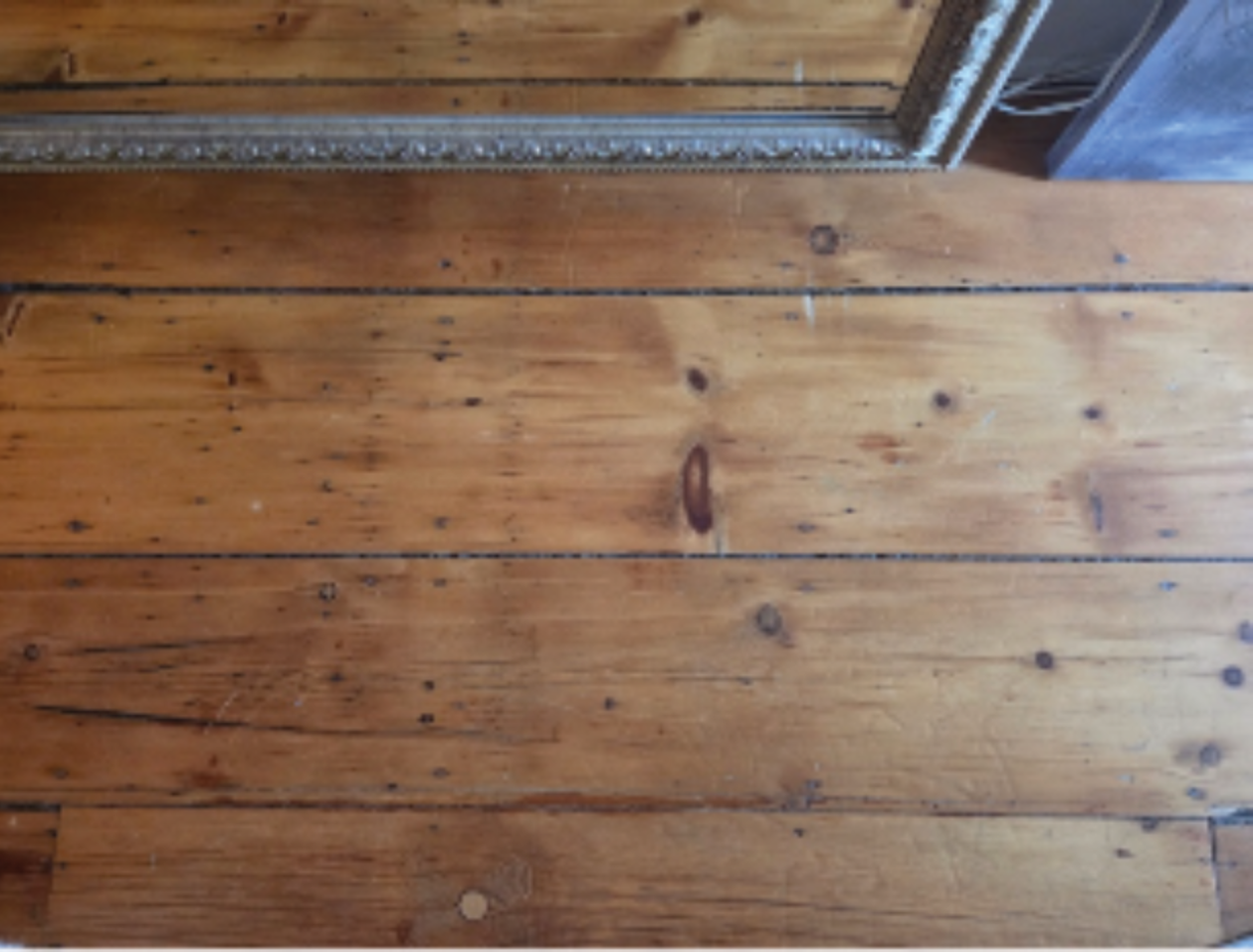
Original floors, 71 W Ferry St.
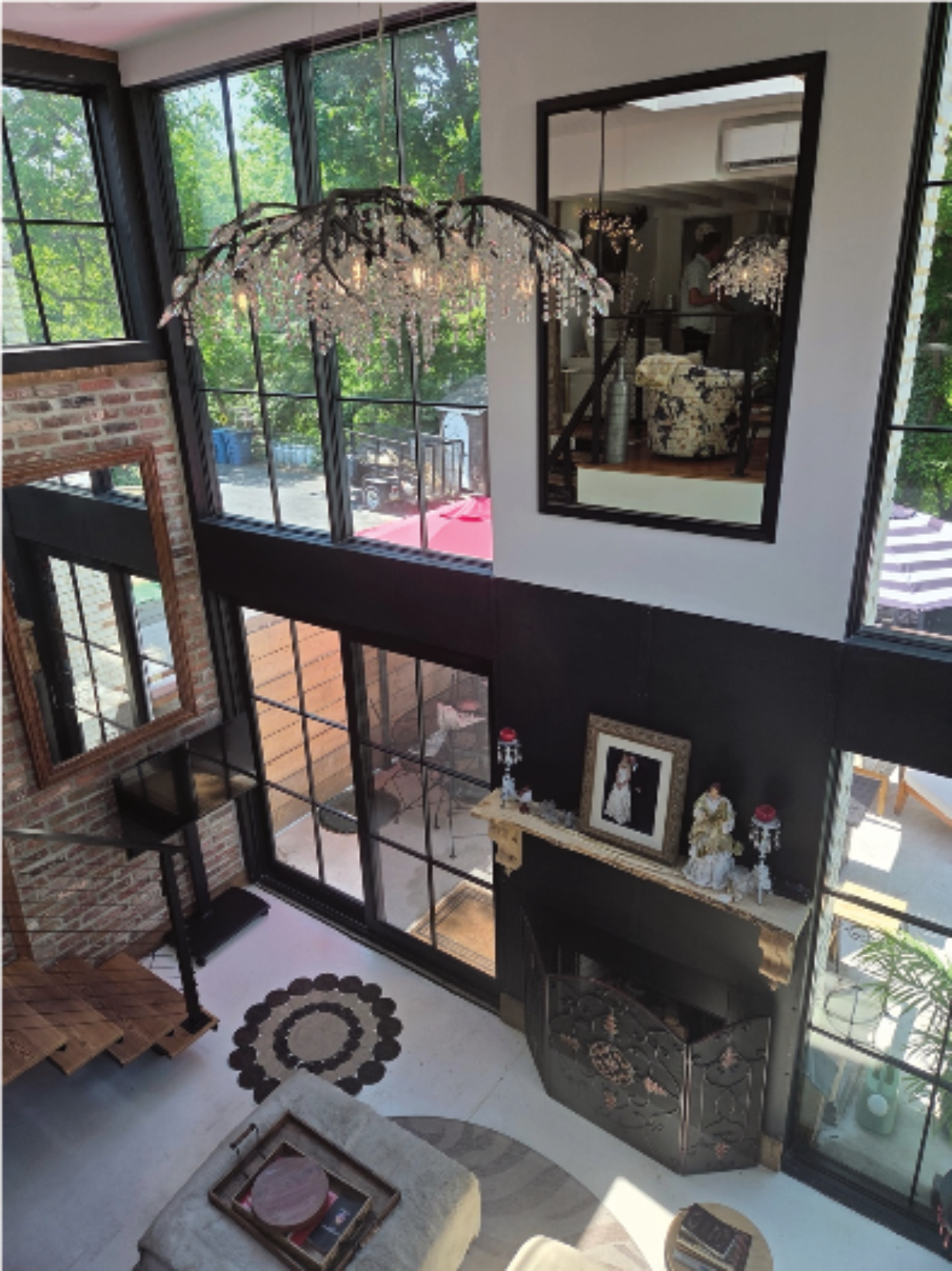
Newest addition to 71 West Ferry Street, with southern view
A master bedroom and bath and deck are found on the 2nd floor with a sitting room. Lou’s office is on the 3rd floor (attic), and the roof was raised to better the view to the creek and allow standing erectly. Lou states that the going joke of Stone Row owners is that ‘you haven’t really moved into Stone Row until you fall down’ the above mentioned preserved circular stairs.
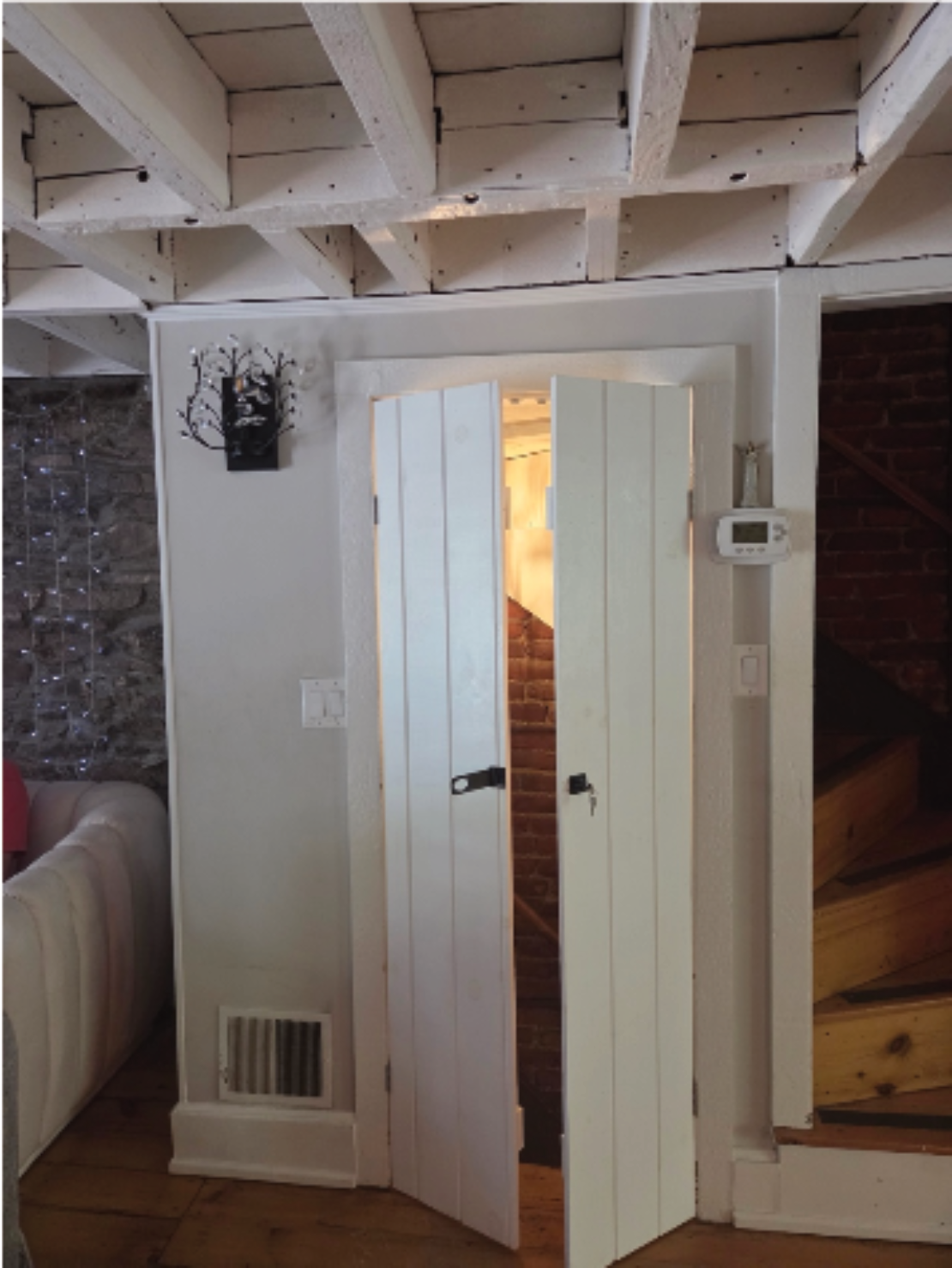
Circular stairs and exposed joists
The basement level is above ground on the southern (creek side) elevation. Here is found a modernized kitchen and sitting area with a view to the south through the two-story windows noted above. Neighbor and NHHS archives volunteer, David Newhart, recalls being in the 71 West Ferry Street home as a child in about 1960 with the then sink having a hand-operated pump for water provision. Shane Blische says that other than the relatively recent southern addition to 71 West Ferry Street, there have been few other significant changes in the row during his nearly three decades of residence.
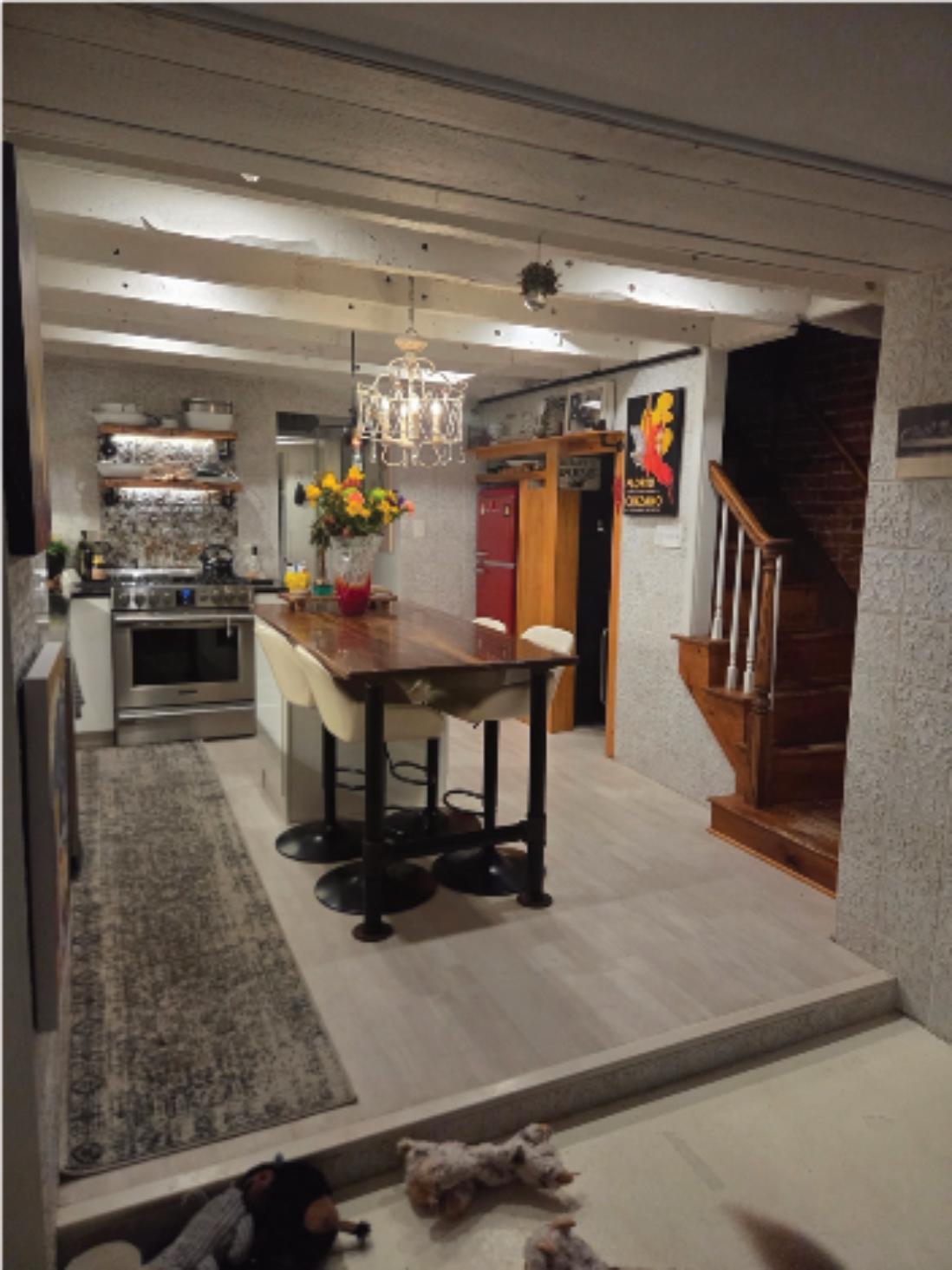
Kitchen
One final note is that some say that Stone Row is haunted. This includes a sad tale of an infant and mother’s death. Ghost tours are known to stop out front to tell such stories. Shane Blische reports having witnessed occurrences that are not easily explained.
Many thanks to Lou Bellafronte for sharing his home with us, Shane Blische for sharing his Stone Row knowledge, as well as NHHS historian Roy Ziegler, and volunteers Michele Gunnells, Tom Lyon, David Newhart, and Tom Williams for their help in creating this article.
If you own or reside in a historic property in New Hope and would be interested in having it featured in our “Beyond the Door” series, please contact us at
Director@Newhopehistorical.org. A year’s free historical society membership is now offered to those who allow us to feature their property.
Beyond The Door