Parry Mansion and Spring House
Beyond the Door
20 December 2025
The Parry Mansion and its Springhouse
45 South Main Street
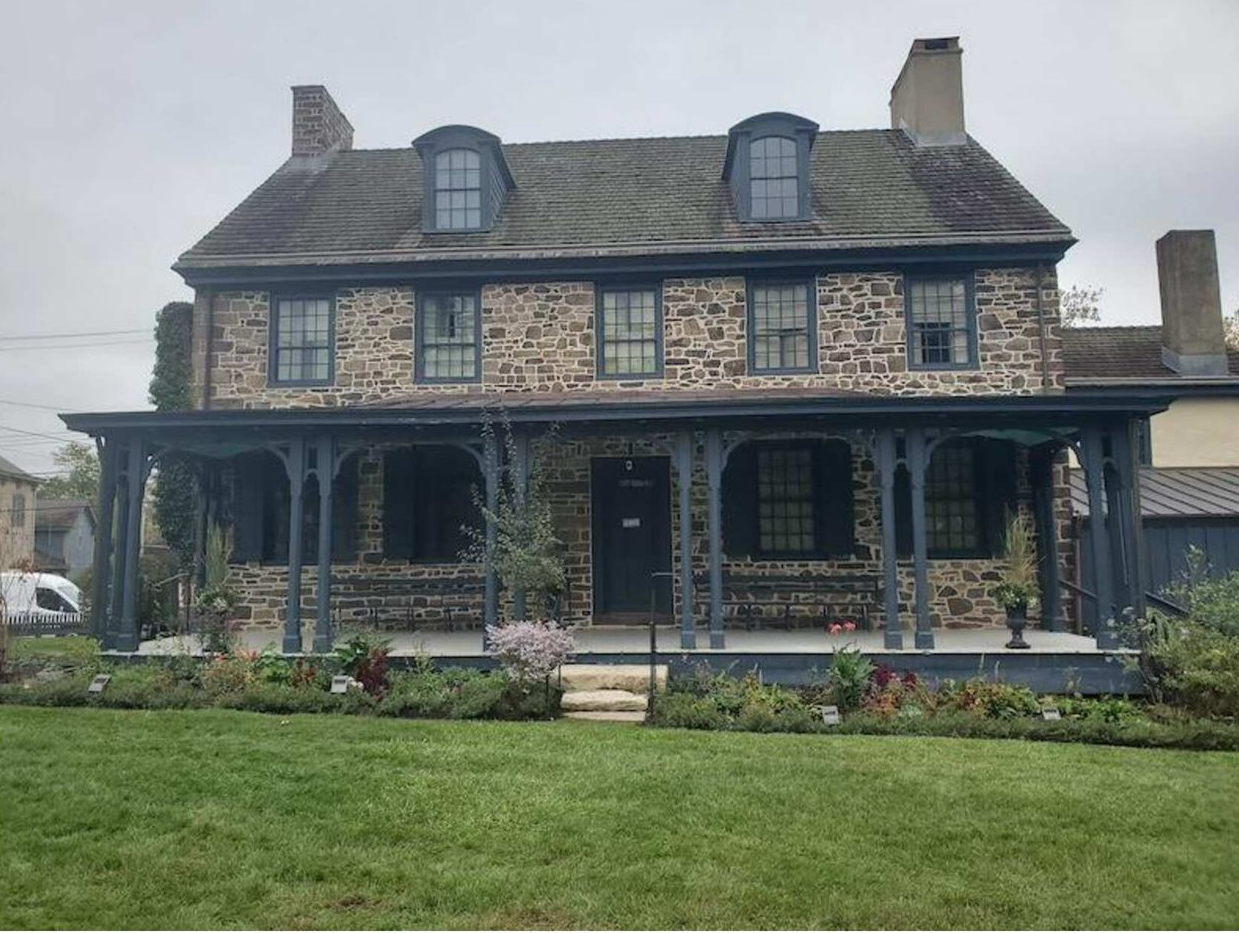
View of Parry Mansion from the west in October, 2025.
The Parry Mansion is one of the most historic and most prominent buildings in New Hope. This article will explore some of the history and architecture of the Parry Mansion and the Parry family members who lived there for five generations. The information comes from interviews with New Hope Historical Society leadership, volunteers, and Jeff Marshall, former president of the Heritage Conservancy and current principal of Open Spaces & Historic Places, LLC. The Historical Society archives also provided valuable content.
John and Margaret Parry, descendants of Welsh Quakers, were owners of a 1,000-acre tract of land in Moreland, Montgomery County, originally granted by William Penn. There they were neighbors to the Todd family. Initial construction of what we now call the Parry Mansion began under the ownership of Joseph Todd, who also owned a mill in Coryell’s Ferry (later called New Hope). When Joseph Todd died in the early 1780s, Todd neighbors John and Margaret Parry and their son Benjamin (1757–1839) took over operation of the mill. From 1783–84, Benjamin Parry completed construction of the Georgian-style center hall colonial home begun by Joseph Todd, and in 1787 he married Jane Paxson (see https://www.newhopehistorical.org/the-northwood-farm-a-witness-to-history). In 1791, after ten years of operating the mill, Benjamin secured full mill ownership by buying out the share of his brother, Thomas. Today, Benjamin Parry is frequently called the “father of New Hope.”
Benjamin Parry was only 27 years old when he completed house construction and developed mills for flour, linseed oil, and lumber on both sides of the Delaware River. His descendants lived in the house until 1966, when it was purchased by the New Hope Historical Society, in part to prevent its potential sale to an oil company and conversion into a gas station.
Over the next seven years, it was restored and then opened as a museum featuring some original Parry items, as well as other items relevant to the various time periods during which it was occupied as a home. Even today, it stands across the street from other original Parry buildings, including Parry’s barn and his grist mill, which is now the Bucks County Playhouse. Immediately adjacent to the home is a springhouse, which will be further described later in this article.

Parry Mansion after snowfall in December, 2025.
The Parry Mansion is a 2½-story fieldstone structure, five bays wide and two bays deep. A kitchen addition to the south, dated approximately 1795–1835, is easily seen from Main Street by its red argillite stone walls, rather than the bluer fieldstone of the main building. Above that kitchen were quarters for servants, now used as the Historical Society offices. A broad wooden porch on the west side dates to the late 1800s. A more modern kitchen was added to the southwest corner in the 1940s by Captain Oliver Randolph Parry (1873–1958), great-grandson of Benjamin Parry. He wanted his resident sisters, Gertrude Parry (1868–1954) and Adelaide Parry (1871–1958), to enjoy a more convenient lifestyle than was possible with the existing colonial hearth kitchen, which is now part of the museum. That 1940s kitchen was updated in 1985 by the Historical Society to support the Mansion’s use for modern functions. Interestingly, the colonial and 1940s kitchen additions were preceded by a third, earlier kitchen; this first kitchen later became the still-existing formal dining room. Its original walk-in fireplace remains hidden inside the south wall of that dining room.

Postcard of Parry Mansion dated 1936.

View of Parry Mansion from the southwest, showing the 1940 kitchen addition in dark blue, and the multi-story colonial kitchen addition to the right of the 1940 addition.

Colonial kitchen interior as it looks today.
The Mansion contains numerous early features. Many of the windows retain their 1700s glass panes. Wood cornices, shutters, and the current front entrance door are also believed to be original. Careful inspection during an archaeological feasibility study in 1985 revealed evidence of a driveway from Main Street to the south side of the property, and a photograph taken in 1966 shows a Main Street curb cut for that driveway. When the Historical Society took possession of the property in 1966, the exterior woodwork was painted black-green and later changed to white. However, research conducted in 2013, which traced through layers of paint, demonstrated that the original color was a dark blue. Society archives note that “the blue color was made with zinc, which was mined locally in the 18th century.” The Mansion’s exterior woodwork has been kept in that dark blue color ever since.

Snapshot of the Mansion in 1969 showing white paint finish.
Further exploring the rooms on the first floor, we first find the exhibit room. Over the years, it was used as a library and as the office of George Parry, MD (1839–1893), grandson of Benjamin Parry. The music room is where Gertrude and Adelaide Parry often entertained guests. They lived in the home for many years, with their niece, Margaret Parry Lang (1901–1985), moving in after their passing. Bedrooms upstairs include the colonial bedroom, which was likely Benjamin Parry’s office, from which he paid his mill workers who entered via the back stairs. A bathroom was not installed until about 1940 and is now shown as the second-floor child’s bedroom. Plumbing was not available in New Hope until approximately 1938.
To the south of the Mansion stands a two-story springhouse. The second floor may have been used as living quarters for servants or visitors, and a fireplace on that level would have been useful for keeping residents warm or for smoking meat. The Historical Society is currently raising funds to rehabilitate the springhouse. One interior wall on the first level—underground and where the spring is believed to have been—has already been shored up with cinderblock, but significant masonry and carpentry repairs are still needed on both levels before the building can be included in tours of the Parry Mansion. The springhouse repairs, along with other necessary work in the 240-year-old Mansion, are understandably costly for a property of this age. Donations to help defray these costs may be made through the New Hope Historical Society website and will be deeply appreciated.
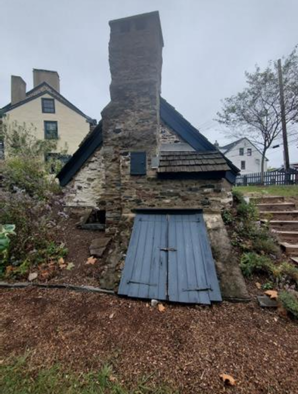
Springhouse from the south

Springhouse from the north
Following the 1958 passing of Adelaide Parry, the home came into the ownership of her niece, Margaret Parry Lang, the last Parry descendant to live there and the great-great-granddaughter of Benjamin Parry. She eventually sold the home to the Historical Society for $65,000 in 1966.

Margaret Parry Lang and her husband Oliver Paul Lang, 1960, standing in the doorway of their home, the Parry Mansion.
In a meeting with Jeff Marshall, he generously provided additional insights based on his on-site observations. These details follow in no particular order. Most houses of this era, including the Parry Mansion, are situated facing southeast to benefit from warming morning sun. The Mansion’s front door appears pre-Revolutionary in that it is flush with the exterior walls and features a pediment to protect it from the weather. The presence of keystones presents a conundrum, as these elements are typically considered post-Revolutionary. Cornerstones at the outside corners of the main house and the kitchen addition indicate that the addition was constructed after the main house. Attic dormers were likely added in the 19th century. The current back (west-side) door once had a pediment, as indicated by three vertical stones above the doorway. The presence of five bays is consistent with ownership by a wealthy family. A basement cistern, still present today, was historically used to store water. Masonry arches in the basement support the fireplaces above, and attic rafter “marriage marks” suggest the rafters were assembled on the ground and then lifted into place. Attics were commonly used for storing valuable grains.

West side Mansion door with vertical stones above indicating a prior pediment.

One of multiple stone arches in the basement, each of which support the fireplaces on the floors above.

Jeff Marshall in the formal dining room where current fireplace masks a colonial era walk-in kitchen fireplace.
Many thanks to the many individuals involved in the preparation of this article: Jeff Marshall, Roy Ziegler, Bobbi Cross, David Newhart, Tom Williams, Wendy Appleton, Michelle Gunnells, Sandie Mines, Tom Lyon, and Vickie Lupisella.
If you own or reside in a historic property in New Hope and would be interested in having it featured in the “Beyond the Door” series, please contact us at Director@Newhopehistorical.org.
A year’s free Historical Society membership is now offered to those who allow us to feature their property.
Beyond The Door